
Related posts
2010 - Music Essay
Blowin' in the Wind
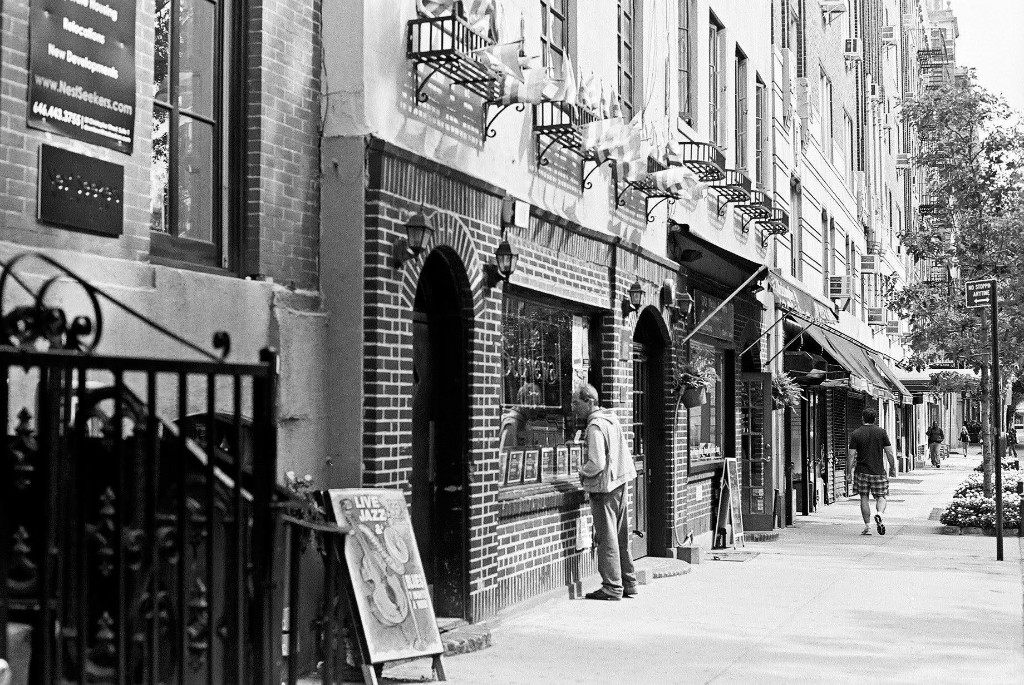
The site of the Stonewall riots, taken in Greenwich Village, New York, Summer 2010.
In the 1990s, against the backdrop of the dissolution of the Soviet Union, the collapse of communist regimes, and the oncoming tide of liberalism, information technology was advancing at a dizzying pace. By the time I was old enough to comprehend the world, human history had crossed into the twenty-first century, and the rhythm of time seemed to spin even faster. Amidst these rapid fluctuations, people constantly looked back to understand history, and I, too, sought a sense of identity within that retrospective view. It wasn't until cultural rebellion and left-leaning ideologies entered my mind through rock 'n' roll that I suddenly realized ideas could actually find a place to dwell.
When rock 'n' roll emerged in the 1950s, it represented the restless anxiety of youth. Moving into the 1960s and 1970s, it underwent drastic transformations; only when it merged with folk music did it gain deeper intellectual substance, beginning to foster an awareness for society and the marginalized. Most unignorable was the influence brought by the Beat Generation, which sparked a series of turning points that reshaped rock music. Bob Dylan can be considered a pivotal juncture in this shift. Emerging alongside rock 'n' roll, he navigated its continuous evolution and carried the weight of a rebellious era.
“The thing about rock'n'roll is that – for me, anyway – it wasn't enough. There were great catch-phrases and driving pulse rhythms… but the songs weren't serious or didn't reflect life in a realistic way. I knew that when I got into folk music, it was more of a serious type of thing. The songs are filled with more despair, more sadness, more triumph, more faith in the supernatural, much deeper feelings.”
Bob Dylan
An immature rock scene led him toward ancient folk music. The popular folk music of that time reflected the voice of the working class and possessed a strong left-wing inclination. These "singing for the people" songs opposed commercialism and modern society, reflecting the genuine realities of bottom-tier life. Dylan became acquainted with folk music from this background, and his subsequent creations were built upon this very foundation.
The Beat Generation consisted of the cultural rebels of post-WWII America, a collective of poets and writers. Behind the seemingly decadent and passive surface of their work lay a highly active and actionable critique.
Dylan arrived in New York's Greenwich Village in 1962. This happened to be the homeland of both folk music and the Beat Generation, where ideas intensely clashed and integrated. Absorbing these diverse elements, he created folk music unlike anything before. He sang loudly of anti-war sentiments and documented reality through music, yet refused to confine himself. When the public labeled him a protest singer, he swiftly distanced himself and attempted to shed the folk label. In a 1966 concert, his choice to plug in an electric guitar completely infuriated folk purists. Looking back from a long-term perspective, however, this move broke through genre boundaries and brought social consciousness to the masses in a more popular, mainstream format.
He went through multiple periods of transformation in his life, but the most significant and monumental one was that he permanently changed rock 'n' roll.
I also traveled alone to New York in the summer of 2010. One of my most important itineraries was to walk through Greenwich Village, to feel the place that nurtured countless cultural foundations. Looking at record stores, pedestrians on the streets, nightlife taverns, and musicians playing on the curbs, I tried to imagine the past from these urban details, visualizing how a young artist started their journey here.
A legendary figure like Bob Dylan, undaunted by the advance of age, continues to wander through various musical genres, remaining incredibly prolific and even heavily rearranging his own classic tracks. To date, he has released over 50 albums, his songs have been covered countless times, and his influence on musicians is immeasurable. People often refer to Dylan as a "living legend" or a "living fossil" because of this.
“I don't write protest songs. I just write out of my own feelings.”
Bob Dylan
My interpretation of this statement is that Dylan's creations are a feedback loop to the messages received under the grand environment of the era, rather than deliberate fabrications. This is why it is clear that the direction of creation should follow one's inner heart, which is precisely why his output remains boundless.
Bob Dylan walked out of the twentieth century, crossed into a new millennium, and moved fluidly across various musical genres like a rolling stone. For me, what Dylan taught me is to be fearless and never stop on the path of creation.
The answer my friend, is blowin' in the wind.